How to Check an International Transfer in Your Bank Statement Step by Step

Match the statement entry to the payment
A bank statement shows movements on one account. A payment confirmation describes a particular transfer. Read them together: a debit from the sender’s account does not, by itself, establish that the recipient has been credited. Equally, a short statement description may omit information that appears in the detailed transaction view.
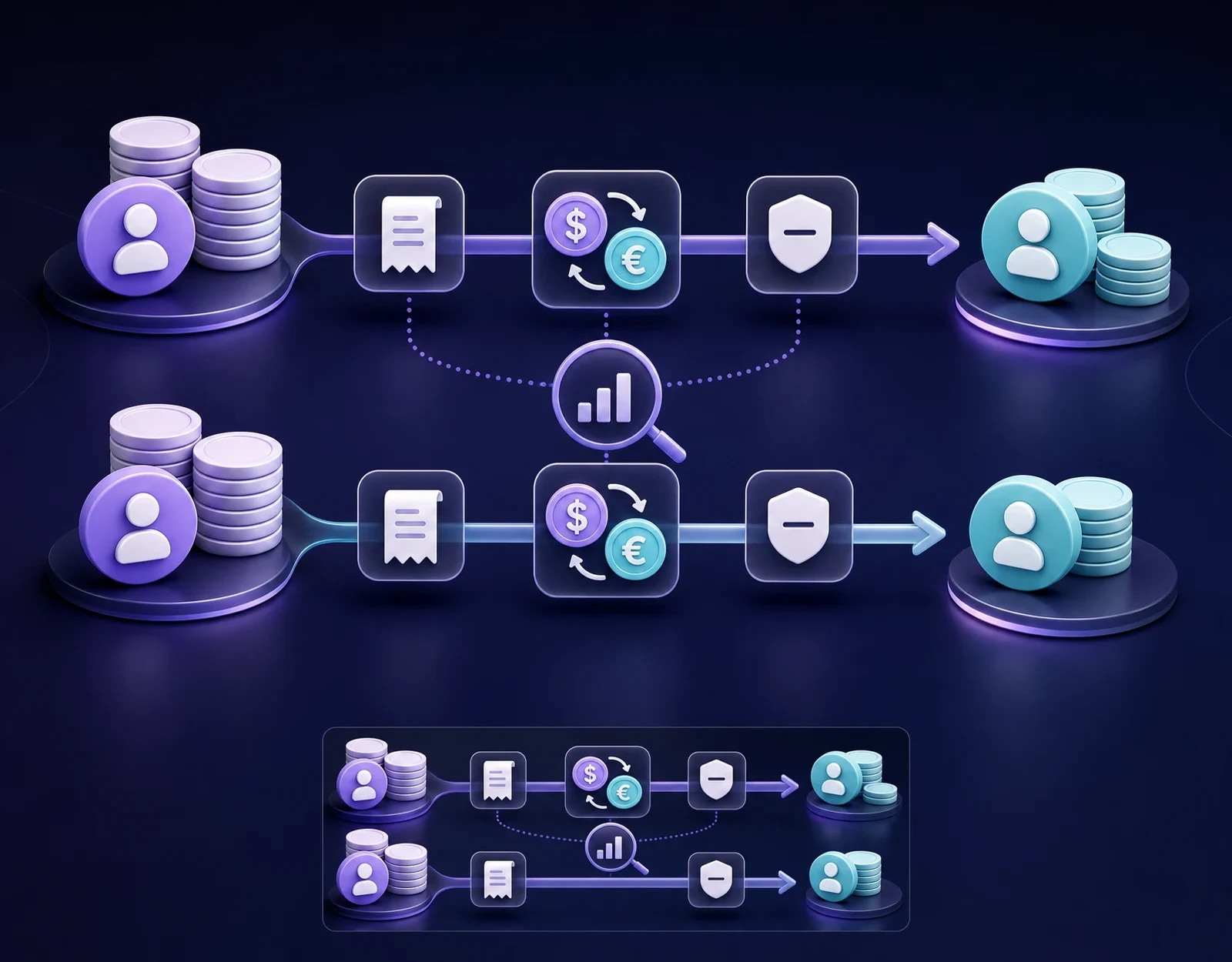
Start with the sender’s confirmation and the recipient’s statement for a period covering the expected posting date. Open the entry details or download the bank’s statement rather than relying on a cropped notification. Match the payment reference, amount, currency and parties. If several transfers have the same amount, the reference becomes especially useful.
Keep the original documents and note which account each comes from. If a payment arrived through a local payout partner, the displayed sender name may differ from the person who initiated it; ask the provider to connect the records. A similar name or date alone is not enough to identify the payment.
Check these fields before comparing amounts
- Booking date and value date: record both where shown. One concerns the account entry; the other is the bank’s value date. Neither alone establishes the time the recipient could use the money.
- Debit or credit, status and reversals: check the direction and whether the record is pending, booked, returned or reversed. Use the bank’s explanation of its labels.
- Amount and currency: distinguish the instructed amount, the amount debited and the amount credited. Copy currency codes, not just symbols.
- Parties and account details: compare the beneficiary name and the available account or IBAN details against the confirmation. A masked number cannot verify the full account.
- Reference and payment description: save the transaction identifier and any invoice or purpose reference. These may be different fields.
- Charges and conversion: look for separate fee entries, the exchange rate and any original-currency amount.
For a Swift payment, ask the bank for the UETR if it is absent. This end-to-end reference helps the banks identify the transfer; it is different from a BIC, which identifies an institution. Other payment routes may use different identifiers. See our guide to checking IBAN and bank details for the account side of the check.
Understand intermediary fees and charge options
A cross-border bank payment may pass through intermediary banks. A charge can appear as a separate debit or reduce the amount passed along, depending on the route and terms. A recipient’s statement may show only the final credit, so an unexplained shortfall does not identify which bank charged it.
Where offered, common charge instructions are OUR, SHA and BEN. Broadly, OUR allocates bank charges to the sender; SHA splits responsibility between sender and recipient; BEN allocates charges to the beneficiary. The available options and their application depend on the payment route and the bank’s terms. Do not assume every international transfer offers all three.
Find the actual instruction in the confirmation, then ask for a breakdown of sender, intermediary and receiving-bank charges. An OUR instruction is relevant evidence when questioning a deduction, but it is not a substitute for the bank’s explanation of the transaction. Keep conversion separate: a less favourable exchange rate is not automatically an intermediary fee.
Reconcile the amounts without guessing
Build a short reconciliation using amounts in the same currency. Start with the instructed transfer amount, subtract documented deductions from that amount, and compare the result with the recipient’s credit. Record sender fees paid separately on another line. Adding those fees to the recipient’s shortfall would mix two different parts of the cost.
Hypothetical example, unrelated to TopSend: the instruction is EUR 1,000. The sender’s account is debited EUR 1,010, comprising the transfer and a separate EUR 10 sender fee. The recipient’s statement shows EUR 985. The EUR 15 difference needs explanation; the statement alone does not prove it is an intermediary charge. If the bank documents a EUR 15 deduction and no conversion, the figures reconcile: EUR 1,000 − EUR 15 = EUR 985.
If currencies differ, first obtain the actual converted amount, applied rate and conversion charges. Do not subtract a USD credit directly from a EUR instruction, or use today’s internet rate as proof of an error. Also check whether a receiving fee was deducted within the credit or posted separately, to avoid counting it twice.
What to do when the figures do not match
- Confirm you are comparing the same payment. Check references, currencies, dates and any reversal or return. Ask the recipient to inspect the full entry, not just a balance change.
- Ask the sending bank or provider for a trace. Supply the confirmation and reference, and ask for the current status, amount forwarded, charge instruction and documented deductions. For Swift, include the UETR if available.
- Ask the receiving bank about the credit. The recipient can request the original incoming amount, conversion details, its own charges and the link to the sender’s reference.
- Request a written reconciliation. Identify the exact unexplained difference. Keep the case number and the next response date. If unresolved, ask for the bank’s formal complaint process; applicable routes and deadlines vary.
A useful message is: “Please reconcile instruction [reference], amount [currency and amount], with credit [currency and amount] on [date]. Please identify conversion, each charge and the payment status, and explain the difference.” Send sensitive documents through the bank’s official secure channel, and remove unrelated transactions where possible. If the payment was unauthorised or the beneficiary details appear wrong, contact the bank promptly instead of waiting for routine reconciliation.
How long should you keep bank statements?
There is no single retention period that this guide can recommend for every country, account and purpose. Check the requirements that apply to your situation with the relevant tax authority or a qualified adviser. Ask your bank separately how far back statements remain available online, how to obtain older copies and whether retrieval costs extra. Online availability is not the same as the period for which you may need your own records.
Download the original statement and keep it with the payment confirmation, fee breakdown and any written reconciliation. Use a folder labelled by year and payment reference, protect access and keep a separate backup. As a practical precaution, keep the evidence while a discrepancy or complaint remains open, then review any continuing record-keeping requirements before deleting it. Before closing an account, save the records you still need rather than assuming portal access will continue.
A final checklist for your records
Before closing the enquiry, make sure the bank’s explanation accounts for the amount, currency and timing. A payment message or sender debit is evidence about the transfer, while the recipient’s booked credit is evidence about receipt on that account. Preserve both when possible.
- One reference ties the instruction and the account entries together.
- Every amount has a currency, account owner and clear role.
- Separate charges and deductions have not been counted twice.
- Any conversion uses the transaction’s actual figures.
- Unexplained differences have a written enquiry and case number.
For a future payment, keep the confirmation before you need it and check what amount is expected to reach the recipient. The TopSend services overview provides product context; confirm the applicable conditions in the service before proceeding. This guide describes a checking method and makes no claim about TopSend fees or delivery times.